Support Derek and GRS

Monday, January 23, 2012

New GRS Zimbabwe Video!


Check out this video - the staff and coaches in this documentary are the very people I work with every single day in Zimbabwe. They are incredibly dedicated and passionate.

Just stopped by the orphanage to set up a soccer game for Saturday morning. I'm going to drop off some cleats for the soccer players and get some pictures (thanks Brown family!). The orphanage has an awesome vibe and I can't wait to start spending more time there. Patience, the social worker in charge, chatted with me today to set up Saturday and then came out to the car to meet Nkosi. She said we should bring him this weekend - the kids will love him. It's the first time she'd patted a dog's head, she said. Dogs are not pets in Zimbabwe, and definitely not members of the family like Nkosi is! I found out the kids call Patience 'Sistah P', so from now on she will officially be Sis P, and no more of this Patience stuff.

So far we've just been settling back in and handling a rush of reports due on 31 January. Yesterday we went to Makokoba for dinner with Esnath, our Zimbabwean mom, and her EXTENDED family. I mean extended. Dinner in the ghetto in Bulawayo means blaring music and every relative you ever had crammed into a tiny flat until they're spilling out the door. It was a very very memorable evening, right down to the two live chickens we purchased in the market and stewed all afternoon to eat with the sadza. Pictures and a full update to come! This is a quick fix because internet has been terrible lately. We were down all weekend and only got it back at 5pm today.

More to come. GO PATS!

Tuesday, January 3, 2012

Emthunzini Wethemba


Imagine 65 children, all orphans, living under one roof. Now imagine that 95% of those who are eligible for school attend classes every single day and that all 65 of them are clothed, fed, and cared for by only a few dedicated community members. This is Emthunzini Wethemba, an orphanage in Mziligazi Township that can’t even afford to pay all of its employees. The chief administrator is retained on a volunteer basis, and all of the employees care for the children as if they were their own. This is the reality of Zimbabwe: AIDS orphans have become Zimbabwe’s children because too many of Zimbabwe’s children have become AIDS orphans.
            By 2009 more than 1 million children, or 71% of all the orphans in Zimbabwe, had been orphaned by AIDS. Several weeks ago, as I prepared to leave for a brief visit to the United States before returning to continue my work with Grassroot Soccer in January 2012, I was searching for a deserving school to collect supplies for. I had been planning to collect clothing from family and friends as best I could when an old friend contacted me with a better solution: Aiden Cudhea, my buddy from Thetford Elementary school in Vermont, and his dad Cameron, would hold a clothing drive at Aiden’s school. I went in search of a recipient for the clothing and donations in the weeks before my return to the U.S., and a Zimbabwean acquaintance pointed me in the direction of Emthunzini Wethemba. What I found is going to change the nature of my relationship with the city of Bulawayo, and I can’t wait to begin playing soccer with the kids at the home and volunteering at the shelter on a weekly basis when I return to Bulawayo next week. Emthunzini Wethemba is a truly amazing place. I wanted to share my glimpse into life at the shelter, and I will continue to post stories and pictures as I volunteer there during the next 5 months.
            The orphanage is located less than 2 km north of Bulawayo City Center along Vic Falls road. It sits adjacent to the Mpilo Hospital OI clinic where Ale and I have spent a significant amount of time since our arrival in Bulawayo in August. The orphanage was founded by the late reverend E. Ndoda in 1992 to care for 6 orphaned boys, and has since expanded to house 65 orphans. The children who live at Emthunzini Wethemba, which translates as “Shelter of Hope,” come to the home from Bulawayo’s social welfare department, from the streets of Bulawayo, or from the Mpilo Hospital Opportunistic Infections clinic when the hospital learns that a child has lost his or her parents or caregivers to AIDS. Therefore, many of the 65 children have spent time on the streets or are AIDS orphans, and 6 of them are HIV-positive through vertical transmission. I had the opportunity to tour Emthunzini Wethemba, visit with the children, and speak with Patience, the volunteer caretaker of the shelter and its 65 young inhabitants, just before Christmas. I was immediately inspired by the sense of hope and joy amongst the children despite their circumstances, and by the dedication and professionalism of the home’s staff and volunteers.
            Despite the seemingly overwhelming odds stacked against AIDS orphans and the crippling lack of resources in Zimbabwe, Emthunzini Wethemba offers hope to the children of Bulawayo. The shelter’s mission is refreshingly simple:
1)      To restore youth to a state of physical, emotional, and spiritual well being sufficient for them to return to a normal lifestyle, preferably within the framework of their family or social structure.
2)      To equip them with entrepreneurial skills and empower them with attitudes and behaviors necessary for employment.
            In pursuit of goal number one, the home employs a young social worker named Patience on a volunteer basis. Patience graduated from the University of Zimbabwe with a degree in social work and psychology. She recently returned to her hometown of Bulawayo to take over the reigns as chief administrator at Emthunzini Wethemba. Patience sets the daily schedule at the home and cares for the children in every way, from setting the daily menu to chasing down the youngest boys attempting to shirk their daily bath. When I arrived at the home at 8:30am on a Thursday morning, Patience explained with an exasperated eye roll that the children were almost ready to greet me but it would be a few minutes because the “big girls” were still finishing with their morning baths and “getting ready.” Apparently teenagers will be teenagers no matter what the time zone or latitude. I laughed and could immediately feel the sense of normalcy and family that pervades the home despite its dilapidated physical appearance and the tragic circumstances that land young people on its doorstep.
            It didn’t take long to discover that Patience is the force behind the discipline and love which are so pivotal to helping the kids regain their sense of normalcy, structure, and hope. As chief administrator, Patience organizes schooling, meals, recreation, chores, and educational enrichment for the children 24/7. All but a handful of the 65 children at Emthunzini are currently attending school in the neighboring community of Mziligazi. Patience tells me proudly that several children have also earned scholarships to local private high schools thanks to their academic performance. The handful of children not attending school consists of those who are beyond schooling age and three who are mentally challenged. The home is currently investigating options for these children, including vocational training for the older children and special needs schools for the children with disabilities. When I visited Emthunzini Wethemba on 15 December, the children were on holiday from school, but Patience had set up a schedule which included morning chores and two hours each of morning and afternoon study time because, she explained, she wants the children to stay intellectually engaged even during their school breaks. This, of course, leads us to goal number two: equipping the children with skills to return to society as productive adults.
            The children live in dorm-style buildings of concrete and brick. I had the opportunity to visit both the girls’ and boys’ dormitories, and despite the fact that the living spaces lack rugs, lamps and many of the comforts we are accustomed to, their wooden bunk beds, brightly colored sheets, and the stuffed animal tucked neatly by each pillow gave an aura of summer camp which made me hopeful that the children are happy here. They certainly seem to be, and the youngest kids loved posing for my camera and were proud to show off the bedrooms they carefully maintain during morning chores. Patience showed me through all the school’s facilities and we made our way to several fields of crops behind the dormitory buildings. The children learn how to farm covo, spinach, and other vegetables at Emthunzini Wethemba. They gather mangoes and bananas from several trees on the property, and have duties to help cook at every meal using the vegetables they have helped to raise.
            Patience showed me a concrete building behind the dormitories that is under renovation. She explained that the city laws do not allow the shelter to retain children over 19 years of age. The 65 children she had introduced me to that morning ranged in age from 5 to 23. The kids older than 19 have graduated from high school and by law they are adults and should be removed from the orphanage. But with 80% unemployment plaguing the country, these young adults with few marketable skills would be thrown back onto the streets of Bulawayo from whence many of them came. Therefore, the shelter continues to provide for these older orphans and gives them increased leadership and mentoring opportunities within the home. Patience is currently working on a project to secure vocational training for the older children at the home. These young adults would then teach classes for the younger kids in order to earn their room and board at the shelter, creating a sustainable model for vocational training and giving the older children productive and fulfilling employment. Patience showed me woodworking equipment and even a pottery wheel in a storage room at the orphanage but explained that the shelter stopped offering classes for its children several years ago when money dried up in the city and no one would volunteer to teach the classes or teach for a modest allowance. Hopefully, now that the economy has sputtered back to life and is growing slowly, Patience will be able to find someone willing to train the older children so that they can breathe new life into vocational classes at Emthunzini Wethemba.
            Through donations from friends and family and the efforts of Aiden and Cameron, I have arranged to bring many donated clothes back to Zimbabwe this week to give to the children at Emthunzini Wethemba. My neighbors, the Brown Family, collected and donated more than 20 pairs of gently used youth soccer cleats. I also have more than $300 donated by my grandmother and aunt which I will use to take Patience on a shopping trip to Fazak’s, the local department store, upon my return to Zimbabwe. Patience explained that the shelter needs everything from pots and pans to curtains, sheets, light bulbs, toiletries, garden tools, utensils, paint brushes, cough medicine, children’s underwear….the list goes on and on. We hope to address a few of these needs.
            Emthunzini is an inspiring place. The shelter employs many practices that we aspire to here in the U.S.: the children learn to farm and grow much of their own food; they often bathe with rainwater collected in a large drum behind the shelter; they live together with few conflicts and maintain their own living spaces through rigorous daily chores; they attend school and several have earned the opportunity to pursue higher education; they live simply and ask for nothing. They do all of this with far fewer resources than we enjoy here at home, and they are extremely deserving. I am excited to have the opportunity to spend more time with them and to learn from their example.
            If you are interested in supporting the kids at Emthunzini Wethemba, please contact me and let me know (dereks@grassrootsoccer.org). You can make a donation to my intern fund online at www.derekinafrica2011.blospot.com and I will use any funds you earmark for the orphanage to help Patience purchase supplies. I can then provide you with a list of exactly what we purchased with your donation so you can see how you contributed! Patience also explained to me that she is trying to set up a new relationship with donors through a program called Friends of Emthunzini Wethemba. Donors may register as a friend to the home for a monthly minimum subscription of $5. This contribution of only $60 for the entire year will serve to raise funds for the daily needs of the home (volunteer stipends, groceries, electric and water bills) and generate income for long term projects such as the training of older members of the Emthunzini family to stay on as vocational counselors and mentors for younger children. I will continue to provide updates and pictures as I deliver the first round of supplies to the orphanage and as our relationship with Emthunzini Wethemba grows this year through soccer games and volunteer work. Thank you for the continued support!

The youth cleats, donated by the Brown family of Hudson, MA, are ready for the journey to Bulawayo. Thank you!


Friday, December 23, 2011

Friday, December 9, 2011

Mrs. Marube


I went for a run this morning like I usually do when we don’t have training. It was grey and overcast and a nice temperature for a jog. I never meet any other joggers and I usually feel a little foolish passing hundreds of people walking to work while I bounce along with my wrap-around ear-buds hooked up to my ipod. Sure, it’s only a 1gig shuffle and it’s about 4 years old, but still. I always greet the people I pass with either “good morning” or “livugile” and most are incredibly friendly, breaking into huge smiles. That’s just how Zimbabweans are.
            As I turned onto the home stretch this morning, running down a road bordered by abandoned, trash-covered fields next to the smelly river that surrounds the city, I passed an older mother with two children tending a small patch of corn. Exams ended last week and school is out for the holidays, so I was happy to know that these two kids are usually at school at 8am on a Friday. But today they were helping their mother with her urban farming. Many families in Bulawayo engage in urban farming, raising crops such as rape and maize on small patches of soil surrounded by crumbling flats and trash-filled alleys. Most patches of arable land in the city are taken up by small gardens and people often carry water long distances to keep their crops alive.
            I greeted the mother as I jogged past the farming family, one of many moving methodically through patches of red soil between the road and the river, hoeing and weeding. Two hundred yards down the road I slid open the heavy black car gate to our yard that squeals like a banshee and really needs to be oiled, and went in to retrieve my camera. Jogging back up the road, camera in hand, I felt foolish again. I wasn’t even sure why I’d brought my camera. My object was not to get a picture for my own use, but to possibly make a copy and give it to the mother and her family if they were neighbors. I’ve seen urban farming going on since we arrived 5 months ago and most of all I just wanted to talk to them and gain some insight into their daily life. Yet I didn’t want to seem like an annoying kiwha or a tourist. I guess it helped that when the mother asked where I stay I was able to point up the road and show her our house, one of the more modest in her very own neighborhood.
            I greeted the mother first and all three stopped working and looked up. Their field wasn’t really a field – the tilled rectangle of land bordered by the burned remnants of other families’ trash piles measured no more than 10 x 20 meters, and I noticed that half of it was filled with weeds. The mother was heavy set and wore the traditional chitenge skirt and a head wrap. She was very sturdily built, and it was clear that her arms and hands had seen many seasons of planting. After an exchange of ‘good mornings’ she introduced herself as Mrs. Marube. I asked her what she was growing (even though I suspected corn), and she cried “maize!” to which I responded, somewhat stupidly, “well, it’s a very nice crop.” At this she snorted, “It could be, but there is no rain,” and pointed to the highest of her corn plants, explaining that all the plants would be this height if the rains had come on schedule. It is now mid-December and we’ve had almost no rain in Bulawayo. The rainy season is supposed to start in October. The lack of rain has been wreaking havoc throughout the country because farmers are afraid to plant too early for fear of drought and lost crops. In the case of Mrs. Marube’s corn, she’d lost more than half to the lack of rain – the section that appeared full of weeds was actually the other half of her field where the corn seedlings had failed to sprout.
            I gestured toward the larger field behind us, bordering the river that doubles as a sewer, and asked why it was not planted. “He just planted yesterday,” she explained. “He waited because of the rain, but finally he could not wait any longer. The seasons, they are changing. We should have rain in October but still we have none.” She shook her head and asked where I stay. Turns out she stays just up the road so we’re neighbors, and the family grows the corn to supplement their income. I didn’t ask further but I assume they sell it to the vendors who then grill it on the side of the road and sell an ear for 6 rand (75 cents). The kids had crept closer as we talked, and I gave each of them a high five and asked how they were. They responded shyly and smiled. Kids in Zimbabwe are incredibly well-behaved and very reserved. Mrs. Marube started to resume hoeing the ground in front of her, and sensing that there was work to be done, I thanked her and asked her if I could take a picture. She asked what I wanted it for and when I told her I would make a copy and bring it to her, she said, “but I am so dirty!” Indeed, the front of her white blouse and her arms, hands, and knees were covered with dirt. I said I would return another time and thanked her. She smiled and resumed her work and I jogged back up the road to take a bucket shower and go to work.
            Mrs. Marube and her family represent one tiny example of how the seasons really are changing in Sub-Saharan Africa. When we first arrived we kept asking locals when the rains would come. It was the end of the dry season and everyone was complaining about the heat (niya chisa!), insisting that the seasons had shifted. I dismissed their comments as exaggeration and alarmism. It seemed so strange to me that a hot-button topic and subject of heated debates in liberal bastions of America should be on the tips of people’s tongues in a nation reeling from one of the worst economic meltdowns in history. Don’t they have better things to worry about? Why are they running around talking about climate change? Are they just saying it to me because I’m American or because I’m white and they think I’ll want to talk about it?
            No - now that I’ve been here a few months, heard from people from all walks of life about the shifting seasons, and witnessed the effects on farmers large and small, my opinion is changing. Zimbabweans talk about climate change amongst themselves. It is a real issue for them. Regardless of whether the change is due to human activity or not, the results are real. It’s not about being liberal or conservative. It’s about identifying a problem and using the resources we have to address it for the good of people less fortunate than ourselves. It’s a bonus that we too will benefit from lower emissions, more sustainable sources of energy, and cleaner air. And don’t we have a moral imperative to address this issue if there is a chance it might alleviate negative effects for people like Mrs. Marube and result in research which could produce cleaner air and energy security for the foreseeable future?
            It is so cosmically unfortunate that due to weather patterns, the pollution contributed by the wealthiest countries ends up affecting climates in some of the poorest areas of the world where people already live on the margins of survival. Sub-Saharan Africa is one of the areas most affected by climate change. We, as Americans, are in a position to make change. The privileged always are. I was so proud of the taxpayers of America after reading this article about the impact that PEPFAR has had on the fight against HIV and AIDS in Africa: http://www.forbes.com/sites/jamesglassman/2011/12/02/how-to-build-on-success-against-aids-in-africa/ . The American people have contributed billions to the fight, whether they know it or not, and we can’t stop there.
            But why doesn’t the same hold for climate change? If you don’t believe in global warming, agree to disagree. But doesn’t it make sense to reduce emissions and seek more sustainable solutions anyway? It’s a win-win situation. We’re going to need them eventually. There is no debate about whether the negative effects of pollution are real. People on the ground, people who have food security issues without throwing drought into the mix, are being affected, so let’s do something about it. It starts in Durban, at the climate conference going on right now. Let’s get the right demographic represented there, and let’s take responsibility, as the most powerful nation in world, for leading the way. I really enjoyed reading this article today about that climate conference going on in Durban South Africa, although it indicates that real progress may be years away - it was a particularly timely read given my conversation with Mrs. Marube this morning. Check it out: http://allafrica.com/stories/201112061052.html


Sunday, December 4, 2011

Esnath and Mattias

I can’t believe I haven’t written about Esnath yet. It’s criminal. Esnath is our Zimbabwean mom, and a wonderful lady. When Ale and I first arrived in Zimbabwe, we stayed at a lodge next to the GRS offices. Esnath keeps house at the lodge, and as we passed 3 weeks there while GRS looked for a house for us to rent in Bulawayo, we bonded with Esnath during many nights without electricity. Esnath cooks the best sadza I’ve ever tasted, and there’s just nothing like a home-cooked Zimbabwean meal when the zesa (power) fails. Eventually the time came for us to move into a new home not far from the office or the lodge. One afternoon before we moved, Ale and I looked at each other and realized how much we were going to miss Esnath and Mattias, the security guard at the lodge. We’d now become very close with both, sharing pictures and stories of our families over meals and staying in the tiny dining room, just the four of us, to chat long after we’d finished eating dinner. Although we live a few blocks from the lodge now, Ale and I have dinner with Esnath and Mattias at least once per week at the lodge. Esnath and Mattias are like family now, and Esnath calls us her Kiwha sons.
            Mattias is a wiry young man, probably in his mid-thirties, with a gap in his teeth and an ever-present smile. He is soft-spoken, with an accent that differentiates him from most of the other Zimbabweans we meet. He provides all-night security at the lodge 5 nights per week. Mattias is one of the Tonga people from Binga, on the shores of Lake Kariba. He speaks Ndebele, English, Shona, and of course his native Tonga. He has a heart of gold and is a talented bike mechanic, and somehow he functions on only 3 to 4 hours’ sleep per night, riding his bike nearly 20 kilometers to work every day. One night after our truck had broken down for the millionth time, Esnath was afraid to allow us to walk home alone from the lodge. Mattias grabbed his bike, walked us home, and then returned to the lodge. While at the house he inspected our locks and our gate (this was shortly after we’d been robbed the first time) and made recommendations for our safety. Mattias has only 2 kids right now but says he wants 5. That way there will be at least one who decides to stay home and care for the aging parents!
        Esnath is from Bulawayo and has 5 children at home. She has been working at the lodge for years and stays in Bulawayo, away from her kids, for the six days per week that she works. When she hops in a combi (commuter bus) to go home, she brings her wages and checks on the kids. One of the older girls does all the cooking at home and gets her siblings to school every day. One day Esnath told us that her daughter had been sent home from school because she’d been late to pay the $110 school fee. For someone who makes $200 per month, that’s a very steep fee. Luckily her daughter is now back at school, but it makes one realize how precious education is. And how inaccessible it can be in Zimbabwe. The net secondary school attendance stands at only around 50%, and an acute shortage of books and supplies plagues most learning institutions and limits the quality of education. I just hope that as the economy here continues to strengthen, education will be prioritized. Sure, the few prestigious boys’ and girls’ private schools in Zimbabwe continue to flourish and offer excellent educations – some of the best for teens in Sub-Saharan Africa. But on the whole, for the average Zimbabwean child, getting a complete education is an uphill battle. Unfortunately, finding an opportunity to apply that education is even tougher. Unemployment peaked at 95% in 2009, forcing many family providers to seek opportunities elsewhere and draining the nation of wealth and expertise. The result is a loss of industry and a persistent lack of job opportunities. For people like Esnath and Mattias, life is far from easy. They work hard day in and day out for themselves and their children, yet unlike many parents in the US, they cannot be confident in a better future for the next generation. They just have to pray and hope for it. However, they can be proud that they both emphasize education and are dedicated to their families. I know I’m thankful that Esnath and Mattias are who they are. They’re two of the reasons I feel at home here in Bulawayo.


 Mattias by the cooking fire.


Esnath dishing the sadza.


Mixty beef! The classic Zimbabwean meal.


Christmas dinner 12/12/11.


Wednesday, November 9, 2011

First VCT Tournament!


GRS Zimbabwe kicked off its VCT campaign in style on 29 October! Here's a press release I wrote after the event that was published in this Saturday's Bulawayo Chronicle. The event was a blast!

First Grassroot Soccer VCT Tournament A Success

Saturday marked the launch of Grassroot Soccer’s Voluntary Counseling and Testing (VCT) Tournament campaign in Bulawayo with soccer celebrities such as Highlanders’ coach Mkhuphali Masuku and captain Gilbert Banda turning out in force to promote HIV testing. GRS Voluntary Counseling and Testing tournaments will bring free HIV testing and other HIV health services to communities throughout Bulawayo in 2011 and 2012. Besides free HIV testing and other health services, each event features a soccer tournament between local high schools and other entertainment such as a DJ, dance groups, and Grassroot Soccer HIV prevention activities and dramas. The first VCT tournament was a huge success, drawing more than 600 community members to the Lobengula Rugby fields on Saturday, 29 October.

The success of the first Grassroot Soccer VCT tournament was made possible by the hard work of many Bulawayo community partners. Local and international partner organizations including Matabeleland AIDS Council (MAC) and Population Services International (PSI) generously offered free HIV testing to community members for more than 6 hours despite the heat of the day. The National AIDS Council (NAC) served as technical advisor for the event and mobilized its Young People’s Network to hand out information on Male Circumcision, Family Planning, Tuberculosis, and HIV/AIDS prevention. Hundreds of young people accessed HIV-related health information throughout the day at information booths set up by the various partners.

Grassroot Soccer has also formed a strategic partnership with Mpilo Hospital as part of its VCT campaign, allowing any HIV-positive youth between 16-19 years of age to be referred directly to the Mpilo OI Clinic for enrollment on ARV treatment with no waiting time. Counselors and Home Based Care Givers from Mpilo also played an invaluable role in VCT tournament preparation. Adolescent HIV counselors from Mpilo first prepared GRS coaches to provide HIV outreach through role-playing and rigorous training sessions.  Teams of GRS coaches and Home-Based Care Givers then ventured into the communities around Lobengula Rugby ground to visit more than 500 households during the two weeks prior to the event, inviting families to the VCT tournament and providing information about the services to be offered. The wild success of this outreach program was evident on Saturday: Chrispen Ngulube, leader of the MAC HIV testing team, remarked on the effectiveness of the door-to-door information visits, stating that MAC had previously provided its standard mobile VCT services in the Lobengula area but never with such a tremendous response from the public. Soccer matches, a festive atmosphere, and door-to-door invitations by Highlanders stars on the day of the event undoubtedly strengthened the community turnout as well.

Male and female students from nearby Masotsha and Njube High Schools competed in a friendly soccer tournament for the opportunity to hoist GRS trophies presented by Highlanders stars Gilbert Banda and Gift Lunga Junior. The girls from Matsosha and boys from Njube prevailed on the day, taking home silverware to be displayed in their schools until the next VCT tournament. DJ Prosper kept the crowds dancing all day long, even during heated matches between GRS coaches and staff including former Highlanders goal-scoring machine Gift Lunga Senior. Highlights of the entertainment program included an HIV drama performed by Gilbert Banda and Gift Lunga Junior, and GRS HIV prevention games led by former Mighty Warriors star and GRS master coach Sithethelelwe ‘Kwinji 15’ Sibanda. Community youth in attendance loved the GRS soccer activities designed to teach facts about HIV and AIDS, the benefits of male circumcision, and how to avoid HIV risks. 

The tournament concluded with the trophy presentation by Gilbert Banda, Gift Lunga Jr., and Highlanders legend Netsai Moyo, who also served as MC for the event. The inaugural GRS VCT tournament in Bulawayo was an enormous success, with more than 600 people in attendance, roughly half of whom elected to undergo HIV testing. GRS looks forward to bringing great community health events to other areas around Bulawayo in the coming weeks, with 3 more tournaments scheduled for 12 November, 19 November, and 3 December. The venues for the events will be announced shortly. To find out the latest Grassroot Soccer Zimbabwe news and more information on upcoming VCT events in your area, visit Grassroot Soccer Zimbabwe’s Facebook page by searching “Grassroot Soccer Zimbabwe.”


Monday, October 31, 2011


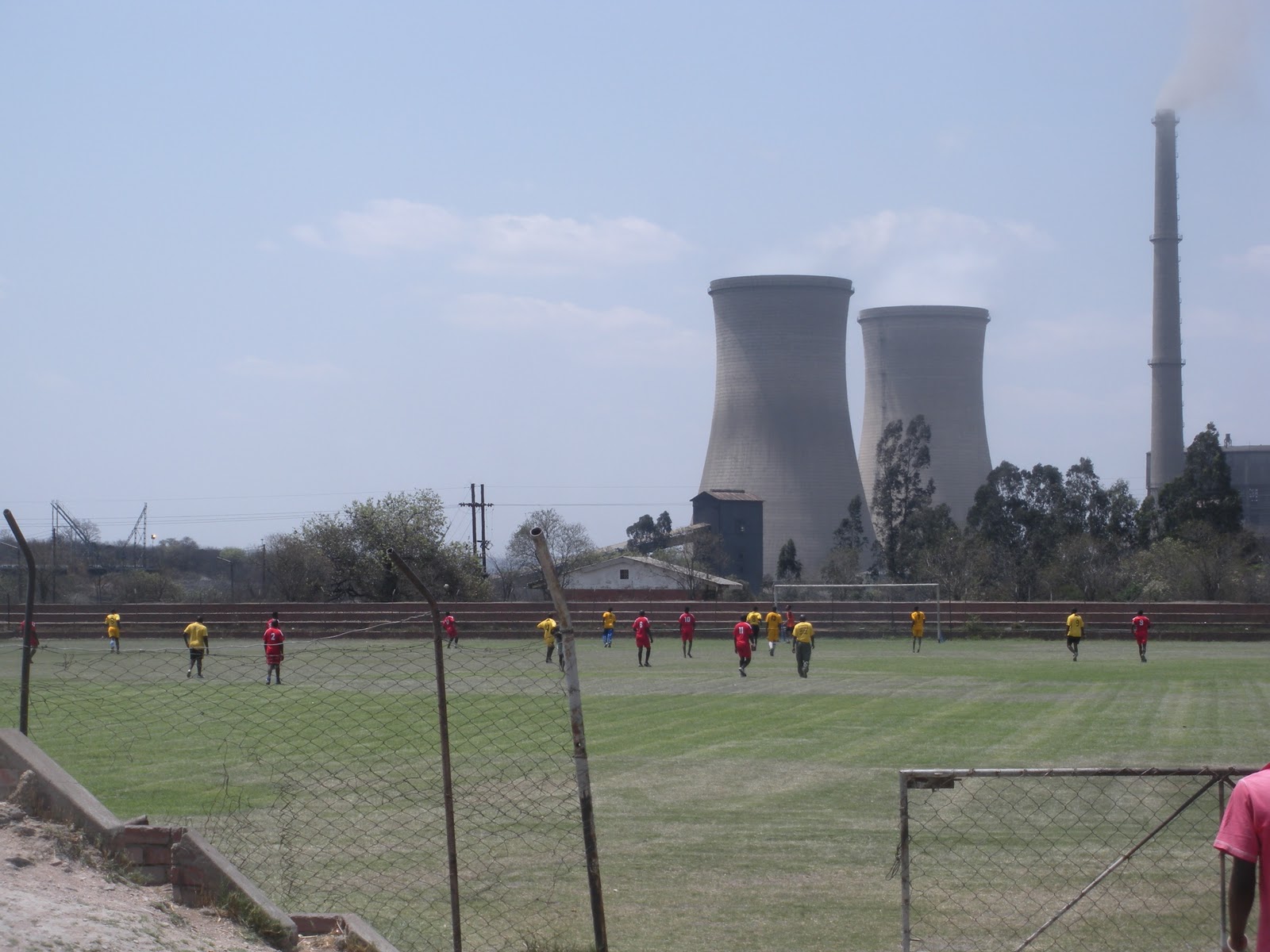
When we went to Vic Falls for a game we played in the shadow of Hwange Power Station. The field was layered with coal dust and my knees were black by the end of the game. The kids from Hwange loved seeing two kiwhas on the team and they chased our bus out of the parking lot.